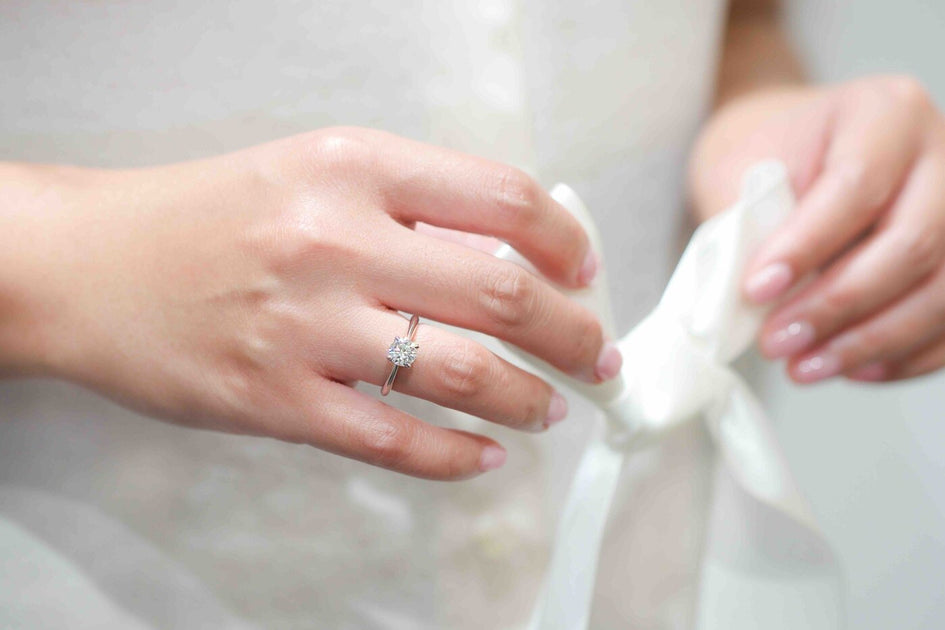





Two colourless stones can look similar in a photograph and noticeably different on your hand. Under jewellery counter lights, both may sparkle intensely. Beside a window, their flashes, facet patterns and apparent depth can tell a different story.
For an engagement ring, the useful comparison goes beyond which stone costs less. You need to understand the appearance you prefer, how much finger coverage feels comfortable and what the finished setting will require. Start by separating three options: natural diamond, lab-grown diamond and moissanite.
Moissanite and lab-grown diamond are different materials
Diamond is crystalline carbon. A lab-grown diamond has essentially the same chemical composition, crystal structure and optical properties as a natural diamond, although its growth origin differs.
Moissanite is silicon carbide. The stones used in modern jewellery are generally laboratory-created, but that does not make them lab-grown diamonds. They are a separate gemstone with their own optical behaviour.
This distinction matters when discussing expectations with a partner or jeweller. Someone who specifically wants a diamond may welcome a laboratory-grown stone but feel differently about moissanite, even if both rings look attractive.
If you are considering Novita Diamonds during your diamond vs moissanites research, first decide whether diamond identity matters to you; that answer determines how relevant a lab-grown diamond comparison will be.
Compare sparkle away from the spotlights
Moissanite disperses light more strongly than diamond, producing pronounced coloured flashes, often described as rainbow fire. Diamond also produces fire, alongside white-light brightness and the changing light-and-dark pattern seen as the stone moves.
Neither appearance is automatically preferable. Some buyers enjoy moissanite’s colourful flashes; others prefer the visual character of a well-cut diamond.
Moissanite is also doubly refractive. Viewed from certain directions, internal facet edges can appear doubled. How noticeable this becomes depends on the cut, viewing angle and stone size. It should not be confused with surface damage or dirt.
A useful viewing routine is to:
- Compare stones of similar dimensions beside a window.
- Move them slowly under ordinary indoor lighting.
- Look from normal hand-viewing distance before using magnification.
- Request videos of the actual stones under matching lighting.
For an oval, examine whether a dark band across the centre remains distracting as it moves. For an emerald cut, inspect the broad flashes and transparency. Shape names alone cannot tell you how an individual stone will perform.
Match millimetres before comparing carats
Carat measures weight, not visible size. Because moissanite and diamond have different densities, equal carat weights do not produce directly equivalent dimensions.
Some moissanite listings use “diamond equivalent weight”, meaning an approximate comparison with the size of a diamond. That figure should not be mistaken for the moissanite’s actual weight.
Ask for length, width and depth in millimetres. Then compare the outline on your finger.
| Buying question | Useful measurement or detail |
|---|---|
| Will the stones look equally large? | Face-up length and width |
| Will an oval look narrow or broad? | Length-to-width ratio |
| Will the ring sit high? | Stone depth and finished setting height |
| Is the advertised weight comparable? | Actual carat weight versus diamond equivalent weight |
For example, two oval stones with the same length can have different widths and create noticeably different finger coverage. A deeper stone may also require a taller setting without giving you a larger face-up appearance.
Paper cut-outs can help establish your preferred footprint before an online consultation.
Scratch resistance does not prevent impact damage
Diamond ranks 10 on the Mohs hardness scale; moissanite is commonly rated around 9.25. Both resist scratching well enough for everyday jewellery, but the numbers do not measure resistance to every kind of damage.
The scale is not linear, and hardness is different from lab created diamonds. Even diamond can chip after an unfortunate impact, particularly at exposed points or vulnerable edges. GIA’s diamond care guidance explains this distinction between scratch resistance and resistance to breaking.
For either stone, examine how the setting protects the outline. Pear tips, marquise ends and princess-cut corners deserve particular attention. Protective claws or an appropriately designed bezel can reduce exposure, although no setting eliminates damage.
Remove an engagement ring before lifting weights or doing manual work. Pressure can damage the metal holding the stone even when the gem itself remains intact.
Price the finished design, including a lab-grown alternative
Moissanite generally costs less than a diamond of comparable visible size, but fixed savings percentages are unreliable. Specifications, seller pricing and the setting all affect the final quote.
If you prefer diamond’s appearance, include a lab-grown diamond in your comparison before compromising on the material. Obtain quotes for similar dimensions and the same metal and setting design.
A larger centre stone can change the whole ring. It may need a wider basket, sit higher or feel less balanced on a narrow band. Savings on the gemstone are more useful when they preserve sound construction.
For Australian orders, request the total in AUD and confirm whether GST, delivery, resizing and any overseas charges are included. Ask separately about return conditions for custom work.
Put stone identity and fit in writing
Before paying a deposit, request an invoice that clearly identifies the centre stone as natural diamond, laboratory-grown diamond or moissanite.
For a diamond supplied with an independent grading report, verify the report number with the issuing laboratory. For moissanite, ask who assigned any colour or clarity descriptions and what those descriptions mean. Similar-looking grades do not establish an equivalent assessment system.
Confirm the ring-sizing system and try a sizing band with a comparable width. Ask for the finished setting height and a side-view image showing how your intended wedding band will sit alongside it. A low basket may leave a gap against a straight band; resolving that detail before manufacture can prevent an avoidable redesign.